About Janitri Innovations
Janitri Innovations Private Limited was established in 2016. Janitri Innovations is a biomedical company developing sustainable solutions in maternal and Child healthcare. We at Janitri are passionate about social healthcare and are working with a vision to see a world where no mothers and newborns die during the pregnancy period and birth. Currently, Janitri focuses efforts on the intrapartum period. Our solution is antepartum and intrapartum monitoring hardware & software.
Need for monitoring pregnancy
Globally, an estimated 2.6 million stillbirths occur every year, accounting for nearly 7,200 stillbirths daily. Mothers and babies are at a greater risk of dying during the intrapartum period, including labor and delivery. Fetal Heart Rate, Uterine Contraction monitoring, and partograph are evidence-based techniques that can help to identify maternal and fetal risk factors so that these can be addressed early.
However, these parameters are monitored inaccurately or ignored due to a lack of manpower and resources in public healthcare facilities leading to intrapartum complications and death.
Most of the deliveries are managed and conducted by staff nurses in low-resource healthcare facilities and lack tools for continuous monitoring and skilled expertise which can lead to a delay in the early detection of intrapartum complications ultimately delaying referral and initiation of treatment.
Current challenges in monitoring pregnancy:
- Public healthcare facilities are inadequately staffed to manage the high load of patients
- The majority of the deliveries are managed by staff nurses and midwives who lack the skills and
expertise to manage high-risk deliveries. - Manual data entry requires time to maintain multiple labor case sheets and delivery registers. In
most cases, these records are filled post-delivery leading to inaccuracy. - Long-term continuous monitoring using CTG causes discomfort to the patients.
- No remote monitoring, experts are required to be present physically.
- Data entry does not trigger a call to action.
Janitri’s solution to improve monitoring during pregnancy
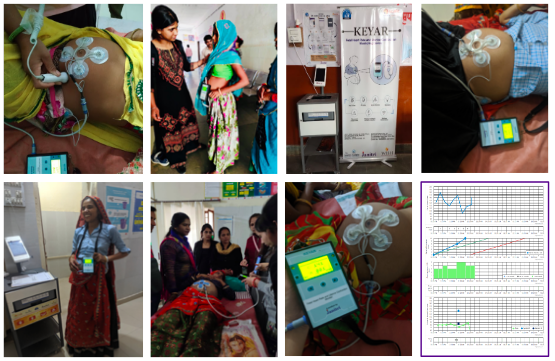
Janitri’s intervention helps monitor fetal heart rate and uterine contraction in an accurate and timely manner. Unlike other available devices, the Janitri device and mobile application provide a real-time view of the data and easy interpretation of data with timely alerts and remote monitoring. The software tool allows healthcare staff to record delivery-related data digitally and automatically generate the partograph and auto-interpret the reports eliminating human error in interpreting the reports.
Janitri has developed and validated a programmatic intervention that includes a device and a mobile application that interacts with the device and provides real-time data view, auto interpretation of complicated graphs, and remote monitoring.
The device
Janitri’s fetal heart rate and uterine contraction device monitor the mother and fetus during the intrapartum period and enables healthcare staff
to make critical decisions related to delivery and care. The key features of the device include;
- The wireless device allows mothers to be mobile before delivery
- Easy and simple to use for healthcare providers
Mobile-Based Application
The mobile-based software interacts with the device and provides a real-time view of the critical parameters. The key features include
- Auto-interpretation of complicated graphs, which eliminates any human error
- Doctors can remotely see the data and take early decisions related to patients
- Digitalization of key parameters of delivery monitoring
Janitri’s Current Programs and Outreach
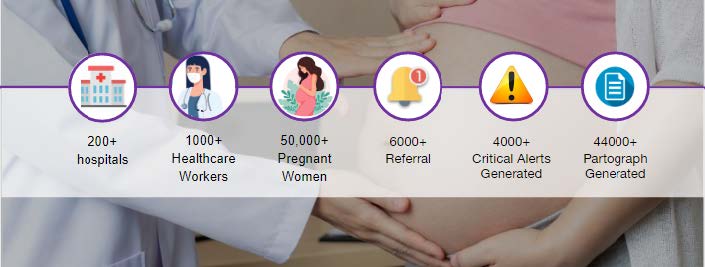
Over the period, we have monitored more than 50,000 pregnant mothers, generated around 44,000 partographs, and trained 1,000 plus healthcare workers across the world in 200 plus hospitals. More than 6,000 referrals are done after n 4,000 critical complication alerts are generated through our software application.
Education & Capacity building
Training and education to healthcare providers on pregnancy monitoring have
been an important component of our programs. We have a well-designed and
proven training module to educate healthcare providers on pregnancy
monitoring, product usage, labor monitoring protocols, and compliance.
Our Training module covers the following aspects:
- Device usage and protocols
- Train labor room staff on device use protocol, and administration
- Clinical parameters
- Reorientation on the importance of monitoring key parameters during delivery
Clinical Evidence and Deployments in Public Healthcare Facilities
Our devices and software applications have been used in centers all across India and in 5 additional countries around the world and has been adopted by state governments and multiple hospitals around the world. The device has significant clinical evidence supporting its effectiveness from government centers, private centers, and rural, tribal, and urban populations. The device intervention has 5 clinical publications published in high-impact journals. We have completed 6 pilots and 4 implementations are ongoing in 4 states.
1. Karnataka State Govt:
- The deployment began with implementation in 5 Primary Health Centres and based on the success was later scaleup in 60 healthcare facilities including level one, level 2, and level 3 (PHCs, CHCs, and district hospitals).
- Total of more than 15,000 women were monitored with the device, and 5000 women were referred to higher centers based on complication-related alerts given by the device.
Rajasthan State Govt Deployment:
- We deployed our intrapartum monitoring solution in 14 govt healthcare facilities in Rajasthan with the state govt and WISH Foundation.
- Total of 7600 women were monitored and more than 600 women were referred to higher centers for the management of early detection of complications by the device.
- The state govt was very happy upon receiving positive feedback from the healthcare providers on the device. It helped them manage a high patient load effectively and efficiently.
Deployments in the North East States in India:
- We deployed our solution in 2 hard to reach hilly terrain states (Meghalaya and Arunachal Pradesh) in India
- 292 pregnancies were monitored, and 37 pregnant women were referred to higher health facilities.
- More than 95% of cases were partograph compliance
- Staff nurses and medical officers concluded that tablet-based partograph is better than paper partograph as it saves time and is easy to use. It is helpful for healthcare workers as it generates reminders and alerts for the patient. There is a need for technology in remote healthcare
settings.
Clinical Publications
- From Guidelines to Practice: Assessing the Implementation Fidelity of Partograph Use for Monitoring Labour in Primary Healthcare Settings in India Using a Tablet-Based Mobile Application: A total of 251 deliveries were monitored using the mobile application at the four rural PHCs. Results showed that adherence to paper partograph was only 1.6% but with the mobile application, the adherence to monitoring vital parameters during pregnancies can be significantly increased. This is published in the Journal of Health & Medical Informatics.
- Scaling up DAKSH intrapartum application: impact, challenges, and learning: this pilot study was initially conducted in 1 block and later on scaled up in the district in Karnataka to understand the usage of the mobile application and incorporate the learnings in the further development of the product. This is published in the International Journal of Community Medicine and Public Health.
- Usability and acceptability of electronic partograph in north India: Studied 292 mothers and found that the software application generated 141 timely alerts on referrals and critical conditions. Healthcare providers found it better than partograph as it saved their time and is easy to use. This is published in the International Journal of Current Research.
- Digital Partograph and Intrapartum Monitoring Mobile Application: Studied 463 pregnancies in 5 govt healthcare facilities in Karnataka. 91.5% of these pregnancies were monitored using mobile applications showing high acceptance of the application among healthcare providers in government healthcare facilities. This is published in the International Journal of Medical Research & Health Sciences.
Case Study 1
Case Study 2